
INTRO
The BPMN 1.0/2.0 bpe_event module provides generic event-handling functionality for BPE. It defines event triggers, boundary limits, timers, and pub/sub message subscriptions.
EVENTS
BPE supports multiple event structures defined in bpe.hrl:
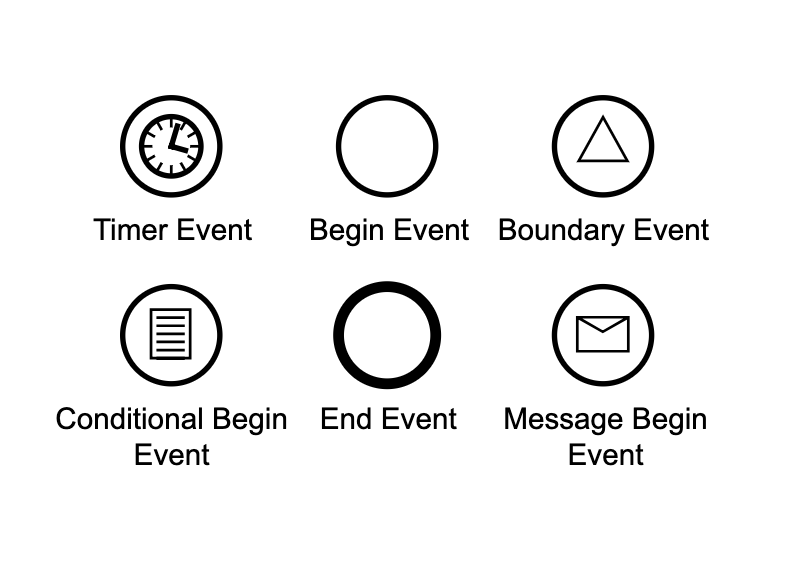
#messageEvent{}
Used to represent synchronous communication events inside workflows.
-record(messageEvent, {
    id      = [] :: [] | list() | binary(),
    topic   = [] :: [] | list() | binary(),
    sender  = [] :: [] | term(),
    timeout = [] :: [] | #timeout{},
    name    = [] :: [] | term(),
    payload = [] :: [] | term()
}).
#asyncEvent{}
Represents asynchronous (cast) communication events inside workflows.
-record(asyncEvent, {
    id      = [] :: [] | list() | binary(),
    sender  = [] :: [] | term(),
    topic   = [] :: [] | list() | binary(),
    name    = [] :: [] | term(),
    payload = [] :: [] | term()
}).
#broadcastEvent{}
Represents system-wide events that are published to multiple subscribers.
-record(broadcastEvent, {
    id      = [] :: [] | list() | binary(),
    sender  = [] :: [] | term(),
    topic   = [] :: [] | list() | binary(),
    type    = immediate :: immediate | delayed,
    name    = [] :: [] | term(),
    payload = [] :: [] | term()
}).
#boundaryEvent{}
An event bound to the boundary of an activity (e.g., a task). It can trigger a timeout or redirect execution when fired.
-record(boundaryEvent, {
    id           = [] :: list() | atom(),
    name         = [] :: list() | binary(),
    prompt       = [] :: list(tuple()),
    etc          = [] :: list({term(), term()}),
    payload      = [] :: [] | binary(),
    timeout      = [] :: [] | #timeout{},
    timeDate     = [] :: [] | binary(),
    timeDuration = [] :: [] | binary(),
    timeCycle    = [] :: [] | binary()
}).
EVENT API
Use these functions to submit events to a process session or manage subscriptions:
messageEvent(procId(), #messageEvent{}) -> {complete, any()} | {error, any()}
Sends a synchronous message event to the process gen_server. It wakes the process if offline, locks it, and runs the handler callback.
Event = #messageEvent{
  name = <<"approval">>,
  payload = <<"approved">>
},
{complete, NextTask} =
  bpe:messageEvent(<<"proc-123">>, Event).
asyncEvent(procId(), #asyncEvent{}) -> ok | {error, any()}
Sends an asynchronous event (cast) to the process gen_server.
Event = #asyncEvent{name = <<"cancel">>},
ok = bpe:asyncEvent(<<"proc-123">>, Event).
broadcastEvent(Topic::binary() | list(), #broadcastEvent{}) -> ok
Publishes a broadcast event to all subscribers of the specified topic.
If the broadcast type is immediate, the target process is immediately loaded and started,
and the message is delivered via gen_server:cast.
If the type is delayed (non-immediate), the message is appended directly to the process's
database queue at /bpe/messages/queue/<ProcId> without waking it up.
Broadcast = #broadcastEvent{
  type = immediate,
  name = <<"new_invoice">>,
  payload = InvoiceId
},
ok = bpe:broadcastEvent(
  <<"finance_topic">>,
  Broadcast
).
subscribe(procId(), Topic::binary() | list()) -> ok | exist
Subscribes a process to a broadcast topic in the database registry.
bpe:subscribe(
  <<"proc-123">>,
  <<"finance_topic">>
).
unsubscribe(procId(), Topic::binary() | list()) -> ok
Unsubscribes a process from a broadcast topic.
bpe:unsubscribe(
  <<"proc-123">>,
  <<"finance_topic">>
).
CALLBACK API
To intercept and process events, you must implement the action/2 callback in your process
module.
The engine redirects event processing to this function:
Module:action({event, Name, Payload}, Proc) -> #result{}
Example handler callback implementation:
-module(my_workflow).
-include_lib("bpe/include/bpe.hrl").
-export([action/2]).

% Handle a synchronous messageEvent
action({event, <<"approval">>, <<"approved">>}, Proc) ->
    logger:info("Invoice was approved!"),
    #result{
      type = reply,
      reply = ok,
      state = Proc#process{status = <<"approved">>}
    };

action({event, EventName, Payload}, Proc) ->
    logger:notice("Unhandled event ~p with payload ~p",
                  [EventName, Payload]),
    #result{
      type = reply,
      reply = {error, unhandled},
      state = Proc
    }.